 c3954441f3
This is a cherry-pick of
ced77b1e9b
with several 3.2 specific alterations.

There are a lot of build issues coming from
old style projects. At this point fixing every
single one of those would require adding patch
after patch to the project file, which is a
considerable amount work and makes the csproj
even more bloated than it already is.

As such I decided this effort would be better
spent back-porting the Sdk style support that's
already available in 4.0-dev to the 3.2 branch.

This will prevent many issues, but it will also
introduce other benefits, among them:

- While target framework stays as .NET Framework
  v4.7.2, it can be changed to .NET Standard 2.0
  or greater if desired.
- It makes it much easier to add future patches.
  They are added to Godot.NET.Sdk and the only
  change required in Godot code is to update the
  Sdk version to use.
- Default Godot define constants are also
  backported, which fixes IDE issues with the
  preprocessor.

There are a few differences in the changes
applied during patching of the csproj compared
to 4.0 with the purpose of preventing breaking
builds:

- 'TargetFramework' stays net472 both for new
  projects and when importing old ones. It can
  be manually changed to netstandard 2.0+ if
  desired though.

The following features are enabled by default for
new projects. Enabling them in imported projects
may result in errors that must be fixed manually:

- 'EnableDefaultCompileItems' is disabled as it
  can result in undesired C# source files being
  included. Existing include items are kept.
  As long as 'EnableDefaultCompileItems' remains
  disabled, Godot will continue taking care of
  adding and removing C# files to the csproj.
- 'GenerateAssemblyInfo' is disabled as it
  guarantees a build error because of conflicts
  between the existing 'AssemblyInfo.cs' and the
  auto-generated one.
- 'Deterministic' is disabled because it doesn't
  like wildcards in the assembly version (1.0.*)
  that was in the old 'AssemblyInfo.cs'.

Of importance:

This is a breaking change. A great effort was
put in avoiding build errors after upgrading a
project, but there may still be exceptions.

This also breaks forward compatibility. Projects
opened with Godot 3.2.3 won't work out of the box
with older Godot versions. This was already the
case with changes introduced in 3.2.2.

Albeit C# support in 3.2.x was still labeled as
alpha, we've been trying to treat it as stable
for some time. Still the amount of problems this
change solves justifies it, but no more changes
that break project compatibility are to be
introduced from now on (at least for 3.x).


Godot Engine

2D and 3D cross-platform game engine
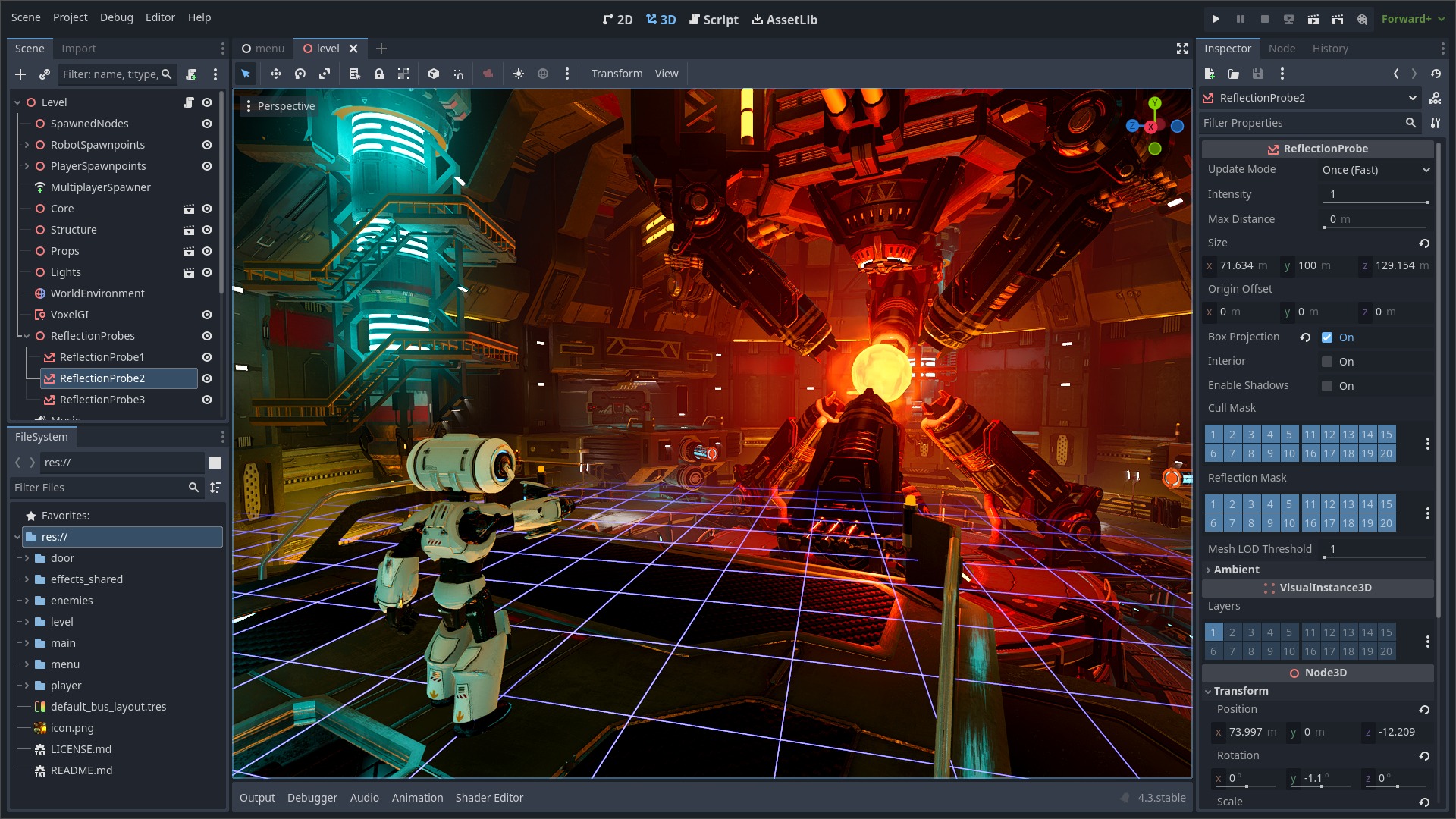
Godot Engine is a feature-packed, cross-platform game engine to create 2D and 3D games from a unified interface. It provides a comprehensive set of common tools, so that users can focus on making games without having to reinvent the wheel. Games can be exported in one click to a number of platforms, including the major desktop platforms (Linux, macOS, Windows), mobile platforms (Android, iOS), as well as Web-based platforms (HTML5) and consoles.
Free, open source and community-driven
Godot is completely free and open source under the very permissive MIT license. No strings attached, no royalties, nothing. The users' games are theirs, down to the last line of engine code. Godot's development is fully independent and community-driven, empowering users to help shape their engine to match their expectations. It is supported by the Software Freedom Conservancy not-for-profit.
Before being open sourced in February 2014, Godot had been developed by Juan Linietsky and Ariel Manzur (both still maintaining the project) for several years as an in-house engine, used to publish several work-for-hire titles.
Getting the engine
Binary downloads
Official binaries for the Godot editor and the export templates can be found on the homepage.
Compiling from source
See the official docs for compilation instructions for every supported platform.
Community and contributing
Godot is not only an engine but an ever-growing community of users and engine developers. The main community channels are listed on the homepage.
To get in touch with the engine developers, the best way is to join the #godotengine-devel IRC channel on Freenode.
To get started contributing to the project, see the contributing guide.
Documentation and demos
The official documentation is hosted on ReadTheDocs. It is maintained by the Godot community in its own GitHub repository.
The class reference is also accessible from the Godot editor.
The official demos are maintained in their own GitHub repository as well.
There are also a number of other learning resources provided by the community, such as text and video tutorials, demos, etc. Consult the community channels for more information.



